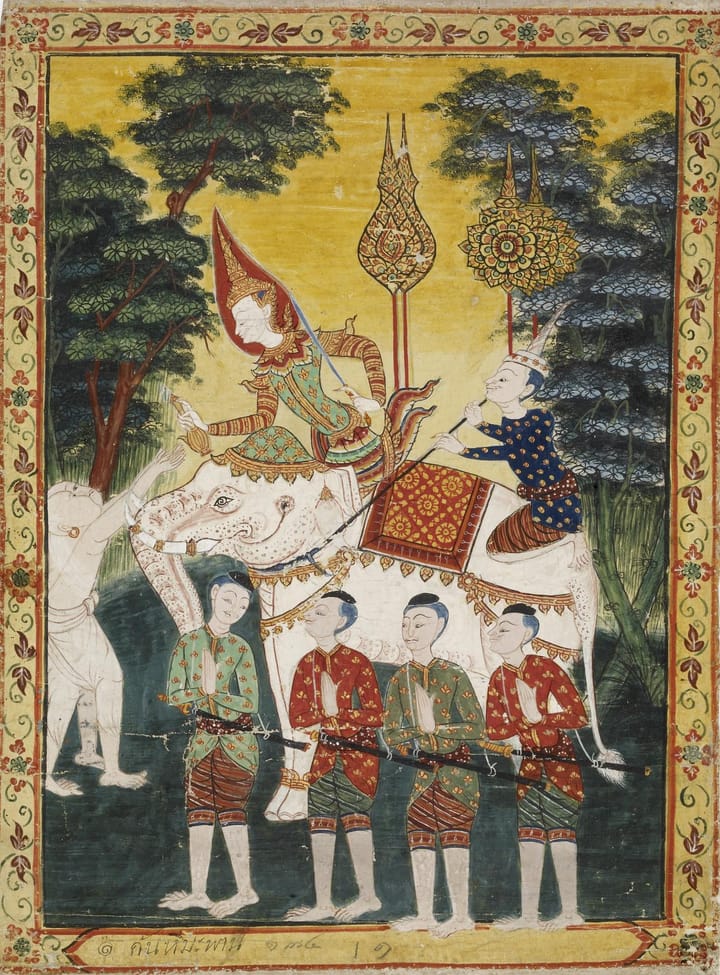
Buddhism Dhp 12 · Self Self-discipline as the foundation of wisdom: taming oneself before attempting to guide or teach others.
Buddhism MN 17 · Forest Hinterlands (Vanapattha Sutta) Criteria for judging whether a forest dwelling supports a monk's mindfulness, concentration, and material needs, or should be abandoned.
Buddhism DN 33 · The Discourse for Reciting Together (Saṅgīti Sutta) Organizes core teachings into numbered lists, from ones to elevens, as a mnemonic device for communal recitation.
Buddhism AN 2:5 · Relentlessly (Appaṭivāṇa Sutta) Aṅguttara Nikāya · AN 2:5. Translated by Ṭhānissaro Bhikkhu.
Buddhism SN 1:36 · Conviction (Saddhā Sutta) Saṁyutta Nikāya · SN 1:36. Translated by Ṭhānissaro Bhikkhu.
Buddhism Dhp 11 · Aging The body's inevitable decay and death, urging contemplation of its foulness beneath youth's beguiling surface.
Buddhism MN 14 · The Lesser Mass of Stress (Cūḷa Dukkhakkhandha Sutta) Explains to Mahānāma why greed, aversion, and delusion still arise despite intellectual understanding, and critiques self-mortification as purification.
Buddhism DN 29 · The Inspiring Discourse (Pāsādika Sutta) Addresses how to handle schism and dispute after a teacher's death, and what marks a complete, trustworthy Dhamma-Vinaya.
Buddhism AN 2:2 · Exertions (Padhāna Sutta) Aṅguttara Nikāya · AN 2:2. Translated by Ṭhānissaro Bhikkhu.
Buddhism SN 1:25 · An Arahant (Arahanta Sutta) Saṁyutta Nikāya · SN 1:25. Translated by Ṭhānissaro Bhikkhu.