Foreword
The Classic of Filial Piety (孝經 Xiao Jing) is one of the Confucian classics. Though, it does not lie separately alongside the Five Classics (the Book of Odes, the Book of Documents, the Book of Changes, the Book of Rites and the lost Book of Music), it is a foundational Confucian text. In Xiao Jing, Confucius discusses with his disciple, Zengzi, filial piety as the source of nascent virtue. Filial devotion (xiao) is described as the “root of virtue” and virtue is seen as first manifested in the natural affection and love children have for their parents.
Filial piety is the root of all virtue, and the stem out of which grows all moral teaching.
Since Confucian morality is inherently metaphysical, it is not surprising that Confucius discusses the metaphysical implications of filial piety. In Xiao Jing, he designates father and mother as correlates to Heaven and Earth, discussing the requirements of both “love and reverence”.
It is also not surprising that Confucianism, which takes great pains in correlating the ruler-people relationship to the parent-child relationship, would discuss the relevance of filial piety to statecraft. However, in Xiao Jing lies one of the most clear equivocations of the Confucian correlation between the state and family.
Finally, the text gives discusses the sorrow present in and the proper rites performed by the filial child. The last passage is heavy laden with grief.
This James Legge translation was one of the earliest translations of Xiao Jing in English (1893), derived from his translation of the Book of Rites. The version here, has been digitised by the Chinese Text Project (CTEXT).
Ben Ajaero
1 · 開宗明義 — The Scope and Meaning of the Treatise
仲尼居,曾子侍。
Chungni (Confucius) was at leisure, and his disciple Zang (Zengzi) was sitting by him in attendance.
子曰:「先王有至德要道,以順天下,民用和睦,上下無怨。
The Master said, "The ancient kings had a perfect virtue and all-embracing rule of conduct, through which they were in accord with all under heaven. By the practice of it the people were brought to live in peace and harmony, and there was no ill-will between superiors and inferiors.
汝知之乎?」
Do you know what it was?"
曾子避席曰:「參不敏,何足以知之?」
Zeng rose from his mat and said, "How should I, Shen, who am so devoid of intelligence, be able to know this?"
子曰:「夫孝,德之本也,教之所由生也。
The Master said, "Now filial piety is the root of all virtue, and the stem out of which grows all moral teaching.
復坐,吾語汝。
Sit down again, and I will explain the subject to you.
身體髮膚,受之父母,不敢毀傷,孝之始也。
Our bodies—to every hair and bit of skin—are received by us from our parents, and we must not presume to injure or wound them. This is the beginning of filial piety.
立身行道,揚名於後世,以顯父母,孝之終也。
When we have established our character by the practice of the filial course, so as to make our name famous in future ages and thereby glorify our parents, this is the end of filial piety.
夫孝,始於事親,中於事君,終於立身。
It commences with the service of parents; it proceeds to the service of the ruler; it is completed by the establishment of character.
《大雅》云:『無念爾祖,聿脩厥德。』」
It is said in the Major Odes of the Kingdom: "Ever think of your ancestor, Cultivating your virtue."
2 · 天子 — Filial Piety in the Son of Heaven
子曰:「愛親者,不敢惡於人;敬親者,不敢慢於人。
The Master said, "He who loves his parents will not dare (to incur the risk of) being hated by any man, and he who reveres his parents will not dare (to incur the risk of) being contemned by any man.
愛敬盡於事親,而德教加於百姓,刑於四海。
When the love and reverence (of the Son of Heaven) are thus carried to the utmost in the service of his parents, the lessons of his virtue affect all the people, and he becomes a pattern to (all within) the four seas.
蓋天子之孝也。
This is the filial piety of the Son of Heaven.
《甫刑》云:『一人有慶,兆民賴之。』」
It is said in (the Marquis of) Fu on Punishments: "The One man will have felicity, and the millions of the people will depend on (what ensures his happiness)."
3 · 諸侯 — Filial Piety in the Princes of States
在上不驕,高而不危。
Above others, and yet free from pride, they dwell on high without peril.
制節謹度,滿而不溢。
Adhering to economy and carefully observant of the rules and laws, they are full without overflowing.
高而不危,所以長守貴也。
To dwell on high without peril is the way long to preserve nobility.
滿而不溢,所以長守富也。
To be full without overflowing is the way long to preserve riches.
富貴不離其身,然後能保其社稷,而和其民人。
When their riches and nobility do not leave their persons, then they are able to preserve the altars of their land and grain, and to secure the harmony of their people and men in office.
蓋諸侯之孝也。
This is the filial piety of the princes of states.
《詩》云:「戰戰兢兢,如臨深淵,如履薄冰。」
It is said in the Book of Poetry: "Be apprehensive, be cautious, As if on the brink of a deep abyss, As if treading on thin ice."
4 · 卿大夫 — Filial Piety in High Ministers and Great Officers
非先王之法服不敢服,非先王之法言不敢道,非先王之德行不敢行。
They do not presume to wear robes other than those appointed by the laws of the ancient kings, nor to speak words other than those sanctioned by their speech, nor to exhibit conduct other than that exemplified by their virtuous ways.
是故非法不言,非道不行;
Thus none of their words being contrary to those sanctions, and none of their actions contrary to the (right) way,
口無擇言,身無擇行。
from their mouths there comes no exceptionable speech, and in their conduct there are found no exceptionable actions.
言滿天下無口過,行滿天下無怨惡。
Their words may fill all under heaven, and no error of speech will be found in them. Their actions may fill all under heaven, and no dissatisfaction or dislike will be awakened by them.
三者備矣,然後能守其宗廟。
When these three things are all complete as they should be, they can then preserve their ancestral temples.
蓋卿、大夫之孝也。
This is the filial piety of high ministers and great officers.
《詩》云:「夙夜匪懈,以事一人。」
It is said in the Book of Poetry: "He is never idle, day or night, In the service of the One man."
5 · 士 — Filial Piety in Inferior Officers
資於事父以事母,而愛同;
As they serve their fathers, so they serve their mothers, and they love them equally.
資於事父以事君,而敬同。
As they serve their fathers, so they serve their rulers, and they reverence them equally.
故母取其愛,而君取其敬,兼之者父也。
Hence love is what is chiefly rendered to the mother, and reverence is what is chiefly rendered to the ruler, while both of these things are given to the father.
故以孝事君則忠,以敬事長則順。
Therefore when they serve their ruler with filial piety, they are loyal; when they serve their superiors with reverence, they are obedient.
忠順不失,以事其上,然後能保其祿位,而守其祭祀。
Not failing in this loyalty and obedience in serving those above them, they are then able to preserve their emoluments and positions, and to maintain their sacrifices.
蓋士之孝也。
This is the filial piety of inferior officers.
《詩》云:「夙興夜寐,無忝爾所生。」
It is said in the Book of Poetry: "Rising early and going to sleep late, Do not disgrace those who gave you birth."
6 · 庶人 — Filial Piety in the Common People
用天之道,分地之利,謹身節用,以養父母,此庶人之孝也。
They follow the course of Heaven (in the revolving seasons); they distinguish the advantages afforded by (different) soils; they are careful of their conduct and economical in their expenditure, in order to nourish their parents. This is the filial piety of the common people.
故自天子至於庶人,孝無終始,而患不及者,未之有也。
Therefore from the Son of Heaven down to the common people, there never has been one whose filial piety was without its beginning and end, on whom calamity did not come.
7 · 三才 — Filial Piety in Relation to the Three Powers
曾子曰:「甚哉,孝之大也!」
The disciple Zeng said, "Immense indeed is the greatness of filial piety!"
子曰:「夫孝,天之經也,地之義也,民之行也。
The Master said, "Yes, filial piety is the constant (method) of Heaven, the righteousness of Earth, and the practical duty of Man.
天地之經,而民是則之。
Heaven and earth invariably pursue the course (that may be thus described), and the people take it as their pattern.
則天之明,因地之利,以順天下。
(The ancient kings) imitated the brilliant luminaries of heaven and acted in accordance with the (varying) advantages afforded by earth, so that they were in accord with all under heaven.
是以其教不肅而成,其政不嚴而治。
In consequence their teachings, without being severe, were successful, and their government, without being rigorous, secured perfect order.
先王見教之可以化民也,是故先之以博愛,而民莫遺其親。
The ancient kings, seeing how teaching could transform the people, set before them (examples of) the most extended love, and none of the people neglected their parents.
陳之德義,而民興行。
They set forth (to them the requirements of) virtue and righteousness, and the people roused themselves to the practice of them.
先之以敬讓,而民不爭。
They went before the people with (examples of) reverence and complaisance, and the people had no contentions.
導之以禮樂,而民和睦。
They led them on by (the rules of) propriety and (the influences of) music, and the people were harmonious and benignant.
示之以好惡,而民知禁。」
They showed them what they loved and what they disliked, and the people understood their prohibitions.
《詩》云:『赫赫師尹,民具爾瞻。』」
It is said in the Book of Poetry: "Awe-inspiring are you, O Grand-Master Yin, And the people all look up to you."
8 · 孝治 — Filial Piety in Government
子曰:「昔者明王之以孝治天下也,
The Master said, "Anciently, when the intelligent kings by means of filial piety ruled all under heaven,
不敢遺小國之臣,而況於公、侯、伯、子、男乎?
they did not dare to receive with disrespect the ministers of small states. How much less would they do so to the dukes, marquises, counts, and barons!
故得萬國之歡心,以事其先王。
Thus it was that they got (the princes of) the myriad states with joyful hearts (to assist them) in the (sacrificial) services to their royal predecessors.
治國者,不敢侮於鰥寡,而況於士民乎?
The rulers of states did not dare to slight wifeless men and widows. How much less would they slight their officers and the people!
故得百姓之歡心,以事其先君。
Thus it was that they got all their people with joyful hearts (to assist them) in serving the rulers, their predecessors.
治家者,不敢失於臣妾,而況於妻子乎?
The heads of clans did not dare to slight their servants and concubines. How much less would they slight their wives and sons!
故得人之歡心,以事其親。
Thus it was that they got their men with joyful hearts (to assist them) in the service of their parents.
夫然,故生則親安之,祭則鬼享之。
In such a state of things, while alive, parents reposed in (the glory of) their sons, and, when sacrificed to, their disembodied spirits enjoyed their offerings.
是以天下和平,災害不生,禍亂不作。
Therefore for all under heaven peace and harmony prevailed; disasters and calamities did not occur; misfortunes and rebellions did not arise.
故明王之以孝治天下也如此。
It is the case that intelligent kings ruled all under heaven through filial piety in this manner.
《詩》云:『有覺德行,四國順之。』」
It is said in the Book of Poetry: "To an upright, virtuous conduct All in the four quarters of the state render obedient homage."
9 · 聖治 — The Government of the Sages
曾子曰:「敢問聖人之德,無以加於孝乎?」
The disciple Zeng said, "I venture to ask whether in the virtue of the sages there was not something greater than filial piety."
子曰:「天地之性,人為貴。
The Master replied, "Of all (creatures with their different) natures produced by Heaven and Earth, man is the noblest.
人之行,莫大於孝。
Of all the actions of man there is none greater than filial piety.
孝莫大於嚴父。
In filial piety there is nothing greater than the reverential awe of one's father.
嚴父莫大於配天,則周公其人也。
In the reverential awe shown to one's father there is nothing greater than the making him the correlate of Heaven. The duke of Zhou was the man who (first) did this.
昔者,周公郊祀後稷以配天,宗祀文王於明堂,以配上帝。
Formerly the duke of Zhou at the border altar sacrificed to Hou Ji as the correlate of Heaven, and in the Brilliant Hall he honored king Wen and sacrificed to him as the correlate of God.
是以四海之內,各以其職來祭。
The consequence was that from (all the states) within the four seas, every (prince) came in the discharge of his duty to (assist in those) sacrifices.
夫聖人之德,又何以加於孝乎?
In the virtue of the sages what besides was there greater than filial piety?
故親生之膝下,以養父母日嚴。
Now the feeling of affection grows up at the parents' knees, and as (the duty of) nourishing those parents is exercised, the affection daily merges in awe.
聖人因嚴以教敬,因親以教愛。
The sages proceeded from the (feeling of) awe to teach (the duties of) reverence, and from (that of) affection to teach (those of) love.
聖人之教,不肅而成,其政不嚴而治,其所因者本也。
The teachings of the sages, without being severe, were successful, and their government, without being rigorous, was effective. What they proceeded from was the root (of filial piety implanted by Heaven).
父子之道,天性也,君臣之義也。
The relation and duties between father and son, (thus belonging to) the Heaven-conferred nature, (contain in them the principle of) righteousness between ruler and subject.
父母生之,續莫大焉。
The son derives his life from his parents, and no greater gift could possibly be transmitted.
君親臨之,厚莫重焉。
His ruler and parent (in one), his father deals with him accordingly, and no generosity could be greater than this.
故不愛其親而愛他人者,謂之悖德;
Hence, he who does not love his parents, but loves other men, is called a rebel against virtue;
不敬其親而敬他人者,謂之悖禮。
and he who does not revere his parents, but reveres other men, is called a rebel against propriety.
以順則逆,民無則焉。
When (the ruler) himself thus acts contrary to (the principles) which should place him in accord (with all men), he presents nothing for the people to imitate.
不在於善,而皆在於凶德,雖得之,君子不貴也。
He has nothing to do with what is good, but entirely and only with what is injurious to virtue. Though he may get (his will, and be above others), the superior man does not give him his approval.
君子則不然,言思可道,行思可樂,德義可尊,作事可法,容止可觀,進退可度,以臨其民。
It is not so with the superior man. He speaks, having thought whether the words should be spoken; he acts, having thought whether his actions are sure to give pleasure. His virtue and righteousness are such as will be honored; what he initiates and does is fit to be imitated; his deportment is worthy of contemplation; his movements in advancing or retiring are all according to the proper rule. In this way does he present himself to the people,
是以其民畏而愛之,則而象之。
who both revere and love him, imitate and become like him.
故能成其德教,而行其政令。」
Thus he is able to make his teaching of virtue successful, and his government and orders to be carried into effect.
《詩》云:『淑人君子,其儀不忒。』」
It is said in the Book of Poetry: "The virtuous man, the princely one, Has nothing wrong in his deportment."
10 · 紀孝行 — An Orderly Description of the Acts of Filial Piety
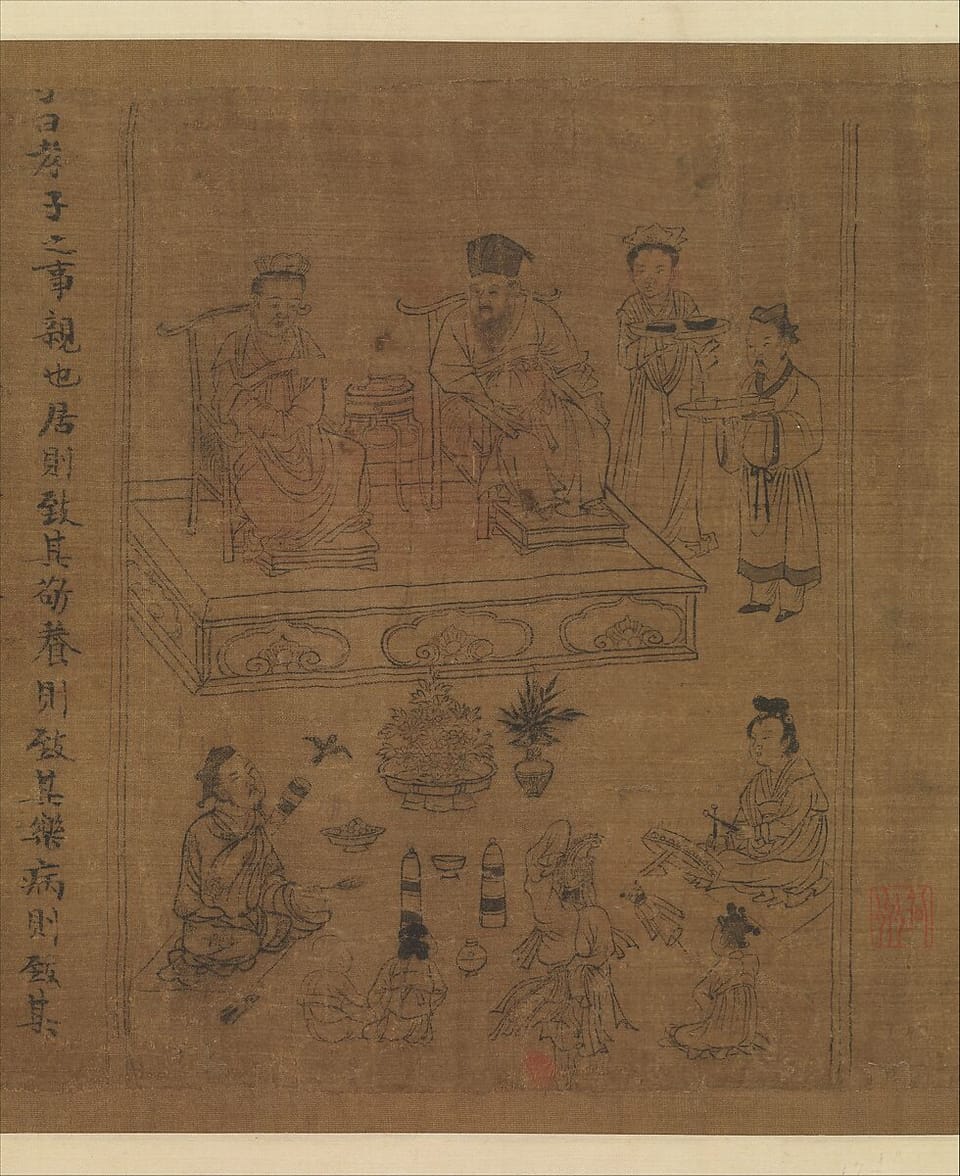
子曰:「孝子之事親也,居則致其敬,養則致其樂,病則致其憂,喪則致其哀,祭則致其嚴。
The Master said, "The service which a filial son does to his parents is as follows: in his general conduct to them, he manifests the utmost reverence. In his nourishing of them, his endeavor is to give them the utmost pleasure. When they are ill, he feels the greatest anxiety. In mourning for them (dead), he exhibits every demonstration of grief. In sacrificing to them, he displays the utmost solemnity.
五者備矣,然後能事親。
When a son is complete in these five things, (he may be pronounced) able to serve his parents.
事親者,居上不驕,為下不亂,在醜不爭。
He who (thus) serves his parents, in a high situation will be free from pride, in a low situation will be free from insubordination, and among his equals will not be quarrelsome.
居上而驕則亡,為下而亂則刑,在醜而爭則兵。
In a high situation pride leads to ruin; in a low situation insubordination leads to punishment; among equals quarrelsomeness leads to the wielding of weapons.
三者不除,雖日用三牲之養,猶為不孝也。」
If those three things be not put away, though a son every day contribute beef, mutton, and pork to nourish his parents, he is not filial."
11 · 五刑 — Filial Piety in Relation to the Five Punishments
子曰:「五刑之屬三千,而罪莫大於不孝。
The Master said, "There are three thousand offenses against which the five punishments are directed, and there is not one of them greater than being unfilial.
要君者無上,非聖人者無法,非孝者無親。
When constraint is put upon a ruler, that is the disowning of his superiority. When the authority of the sages is disallowed, that is the disowning of (all) law. When filial piety is put aside, that is the disowning of the principle of affection.
此大亂之道也。」
These (three things) pave the way to anarchy."
12 · 廣要道 — Amplification of "The All-embracing Rule of Conduct" in Chapter I
子曰:「教民親愛,莫善於孝。
The Master said, "For teaching the people to be affectionate and loving, there is nothing better than filial piety.
教民禮順,莫善於悌。
For teaching them (the observance of) propriety and submissiveness, there is nothing better than fraternal duty.
移風易俗,莫善於樂。
For changing their manners and altering their customs, there is nothing better than music.
安上治民,莫善於禮。
For securing the repose of superiors and the good order of the people, there is nothing better than the rules of propriety.
禮者,敬而已矣。
The rules of propriety are simply (the development of) the principle of reverence.
故敬其父,則子悅;
Therefore the reverence paid to a father makes (all) sons pleased.
敬其兄,則弟悅;
The reverence paid to an elder brother makes (all) younger brothers pleased.
敬其君,則臣悅;
The reverence paid to a ruler makes (all) subjects pleased.
敬一人,而千萬人悅。
The reverence paid to the One man makes thousands and myriads of men pleased.
所敬者寡,而悅者眾,此之謂要道也。」
The reverence is paid to a few, and the pleasure extends to many. This is what is meant by an 'All-embracing Rule of Conduct.'"
13 · 廣至德 — Amplification of 'the Perfect Virtue' in Chapter I
子曰:「君子之教以孝也,非家至而日見之也。
The Master said, "The teaching of filial piety by the superior man does not require that he should go to family after family and daily see the members of each.
教以孝,所以敬天下之為人父者也。
His teaching of filial piety is a tribute of reverence to all the fathers under heaven.
教以悌,所以敬天下之為人兄者也。
His teaching of fraternal submission is a tribute of reverence to all the elder brothers under heaven.
教以臣,所以敬天下之為人君者也。
His teaching of the duty of a subject is a tribute of reverence to all the rulers under heaven.
《詩》云:『愷悌君子,民之父母。』
It is said in the Book of Poetry: "The happy and courteous sovereign Is the parent of the people."
非至德,其孰能順民如此其大者乎!」
If it were not a perfect virtue, how could it be recognized as in accordance with their nature by the people so extensively as this?"
14 · 廣揚名 — Amplification of "Making our Name Famous" in Chapter I
子曰:「君子之事親孝,故忠可移於君。
The Master said, "The filial piety with which the superior man serves his parents may be transferred as loyalty to the ruler.
事兄悌,故順可移於長。
The fraternal duty with which he serves his elder brother may be transferred as submissive deference to elders.
居家理,故治可移於官。
His regulation of his family may be transferred as good government in any official position.
是以行成於內,而名立於後世矣。」
Therefore, when his conduct is thus successful in his inner (private) circle, his name will be established (and transmitted) to future generations."
15 · 諫諍 — Filial Piety in Relation to Reproof and Remonstrance
曾子曰:「若夫慈愛、恭敬、安親、揚名,則聞命矣。
The disciple Zeng said, "I have heard your instructions on the affection of love, on respect and reverence, on giving repose to (the minds of) our parents, and on making our names famous.
敢問子從父之令,可謂孝乎?」
I would venture to ask if (simple) obedience to the orders of one's father can be pronounced filial piety."
子曰:「是何言與,是何言與!
The Master replied, "What words are these! What words are these!
昔者天子有爭臣七人,雖無道,不失其天下;
Anciently, if the Son of Heaven had seven ministers who would remonstrate with him, although he had not right methods of government, he would not lose his possession of the kingdom.
諸侯有爭臣五人,雖無道,不失其國;
If the prince of a state had five such ministers, though his measures might be equally wrong, he would not lose his state.
大夫有爭臣三人,雖無道,不失其家;
If a great officer had three, he would not, in a similar case, lose (the headship of) his clan.
士有爭友,則身不離於令名;
If an inferior officer had a friend who would remonstrate with him, a good name would not cease to be connected with his character.
父有爭子,則身不陷於不義。
And the father who had a son that would remonstrate with him would not sink into the gulf of unrighteous deeds.
故當不義,則子不可以不爭於父,臣不可以不爭於君;
Therefore when a case of unrighteous conduct is concerned, a son must by no means keep from remonstrating with his father, nor a minister from remonstrating with his ruler.
故當不義,則爭之。
Hence, since remonstrance is required in the case of unrighteous conduct,
從父之令,又焉得為孝乎!」
how can (simple) obedience to the orders of a father be accounted filial piety?"
16 · 感應 — The Influence of Filial Piety and the Response to It
子曰:「昔者明王事父孝,故事天明;
The Master said, "Anciently, the intelligent kings served their fathers with filial piety, and therefore they served Heaven with intelligence.
事母孝,故事地察;
They served their mothers with filial piety, and therefore they served Earth with discrimination.
長幼順,故上下治。
They pursued the right course with reference to their (own) seniors and juniors, and therefore they secured the regulation of the relations between superiors and inferiors (throughout the kingdom).
天地明察,神明彰矣。
When Heaven and Earth were served with intelligence and discrimination, the spiritual intelligences displayed (their retributive power).
故雖天子,必有尊也,言有父也;必有先也,言有兄也。
Therefore even the Son of Heaven must have some whom he honors; that is, he has his uncles of his surname. He must have some to whom he concedes the precedence; that is, he has his cousins, who bear the same surname and are older than himself.
宗廟致敬,不忘親也;修身慎行,恐辱先也。
In the ancestral temple he manifests the utmost reverence, showing that he does not forget his parents. He cultivates his person and is careful of his conduct, fearing lest he should disgrace his predecessors.
宗廟致敬,鬼神著矣。
When in the ancestral temple he exhibits the utmost reverence, the spirits of the departed manifest themselves.
孝悌之至,通於神明,光於四海,無所不通。
Perfect filial piety and fraternal duty reach to (and move) the spiritual intelligences and diffuse their light on all within the four seas. They penetrate everywhere.
《詩》云:『自西自東,自南自北,無思不服。』」
It is said in the Book of Poetry: "From the west to the east, From the south to the north, There was not a thought but did him homage."
17 · 事君 — The Service of the Ruler
子曰:「君子之事上也,進思盡忠,退思補過,
The Master said, "The superior man serves his ruler in such a way that, when at court in his presence, his thought is how to discharge his loyal duty to the utmost, and when he retires from it, his thought is how to amend his errors.
將順其美,匡救其惡,
He carries out with deference the measures springing from his excellent qualities and rectifies him (only) to save him from what are evil.
故上下能相親也。
Hence, as the superior and inferior, they are able to have an affection for each other.
《詩》云:『心乎愛矣,遐不謂矣,中心藏之,何日忘之。』」
It is said in the Book of Poetry: "In my heart I love him, And why should I not say so? In the core of my heart I keep him, And never will forget him."
18 · 喪親 — Filial Piety in Mourning for Parents
子曰:「孝子之喪親也,哭不偯,禮無容,言不文,服美不安,聞樂不樂,食旨不甘,此哀戚之情也。
The Master said, "When a filial son is mourning for a parent, he wails, but not with a prolonged sobbing. In the movements of ceremony he pays no attention to his appearance. His words are without elegance of phrase. He cannot bear to wear fine clothes. When he hears music, he feels no delight. When he eats a delicacy, he is not conscious of its flavor. Such is the nature of grief and sorrow.
三日而食,教民無以死傷生。
After three days he may partake of food, for thus the people are taught that the living should not be injured on account of the dead,
毀不滅性,此聖人之政也。
and that emaciation must not be carried to the extinction of life. Such is the rule of the sages.
喪不過三年,示民有終也。
The period of mourning does not go beyond three years, to show the people that it must have an end.
為之棺槨衣衾而舉之,陳其簠簋而哀戚之;
An inner and outer coffin are made; the grave-clothes also are put on, and the shroud; and (the body) is lifted (into the coffin). The sacrificial vessels, round and square, are (regularly) set forth, and (the sight of them) fills (the mourners) with (fresh) distress.
擗踴哭泣,哀以送之;
The women beat their breasts, and the men stamp with their feet, wailing and weeping, while they sorrowfully escort the coffin to the grave.
卜其宅兆,而安措之。
They consult the tortoise-shell to determine the grave and the ground about it, and there they lay the body in peace.
為之宗廟,以鬼享之;
They prepare the ancestral temple (to receive the tablet of the departed), and there they present offerings to the disembodied spirit.
春秋祭祀,以時思之。
In spring and autumn they offer sacrifices, thinking of the deceased as the seasons come round.
生事愛敬,死事哀戚,生民之本盡矣,死生之義備矣,孝子之事親終矣。」
The services of love and reverence to parents when alive, and those of grief and sorrow to them when dead: these completely discharge the fundamental duty of living men. The righteous claims of life and death are all satisfied, and the filial son's service of his parents is completed."
Original text (《孝經》) and James Legge’s English translation are reproduced from the Chinese Text Project, which digitised them; both are in the public domain. Digital source: Sturgeon, Donald (ed.). 2011. Chinese Text Project. https://ctext.org/xiao-jing.