Confucius
The Analects · Book IV — 里仁 (Lǐ Rén)
Book IV of the Confucian Analects (里仁, “On Virtue”), Classical Chinese with James Legge’s English — 26 passages.
The Analects · Book III — 八佾 (Bā Yì)
Book III of the Confucian Analects (八佾, “Eight Rows of Dancers”), Classical Chinese with James Legge’s English — 26 passages.
The Analects · Book II — 為政 (Wéi Zhèng)
Book II of the Confucian Analects (為政, “On Government”), Classical Chinese with James Legge’s English — 24 passages.
The Analects · Book I — 學而 (Xué Ér)
Book I of the Confucian Analects (學而, “On Learning”), Classical Chinese with James Legge’s English — 16 passages.
The Doctrine of the Mean · 中庸 (Zhōngyōng)
《中庸》— the Confucian treatise on equilibrium, harmony and sincerity, traditionally ascribed to Confucius’s grandson Zisi (Kǒng Jí). One of the Four Books. Translated by James Legge.
The Great Learning · 大學 (Dàxué)
《大學》— the first of the Four Books: the Confucian gateway from self-cultivation to the ordering of the state. The text is ascribed to Confucius, its commentary to his disciple Zengzi. Translated by James Legge.
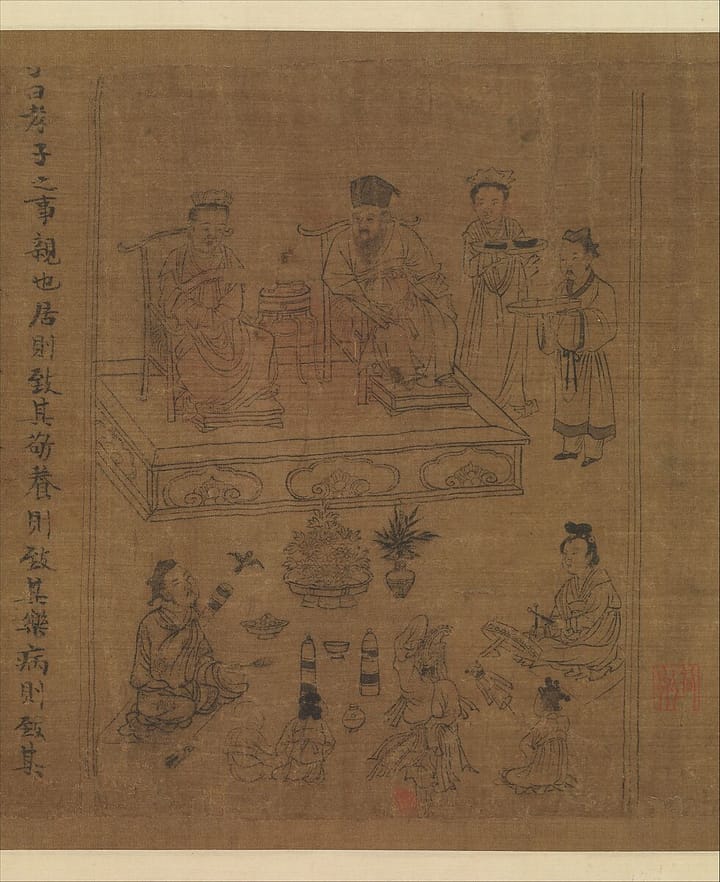
The Classic of Filial Piety (孝經 Xiao Jing) (trans. James Legge)
The Classic of Filial Piety (孝經 Xiao Jing) is one of the Confucian classics. In Xiao Jing, Confucius discusses with his disciple, Zengzi, filial piety as the source of nascent virtue.